
Apple increased iPhone shipments by 3% year over year in the second quarter of 2026, outperforming a slowing global smartphone market, according to Counterpoint Research.
The growth helped Apple achieve a record 20% share of global smartphone shipments during the quarter. Counterpoint also noted that Apple was the only major smartphone manufacturer that did not increase prices despite ongoing memory shortages affecting the industry.
Samsung regains the top spot
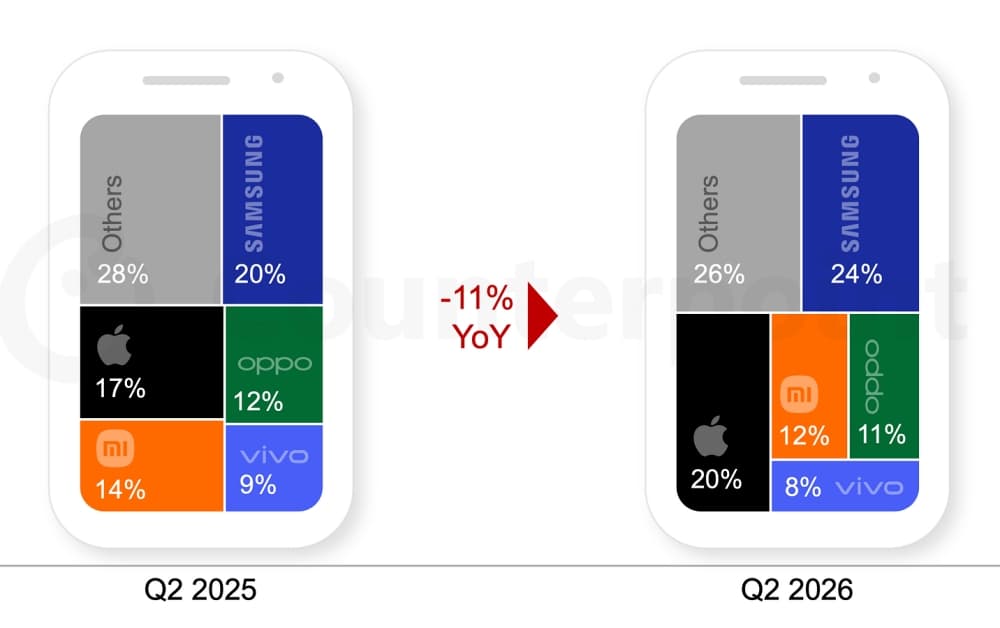
According to Counterpoint Research, Samsung led the global smartphone market in Q2 2026 with a 24% shipment share, followed by Apple with 20%.
The rest of the top five included:
- Samsung: 24%
- Apple: 20%
- Xiaomi: 12%
- OPPO: 11%
- vivo: 8%
Compared with the same quarter last year, Samsung gained four percentage points of market share, while Apple added three points. Vivo gained one point, whereas Xiaomi and OPPO both lost market share. The combined share of all other smartphone brands declined from 28% to 26%.
Samsung reclaimed the top position after Apple led the market in the first quarter, driven by strong demand for the iPhone 17 lineup. Counterpoint attributes Samsung’s comeback to the Galaxy S26 series, improved product availability, and aggressive promotional campaigns.
iPhone 17 demand helped Apple weather the slowdown
Counterpoint says consistent demand for the iPhone 17 lineup enabled Apple to grow shipments despite softer overall market conditions. The research firm also reports that the iPhone 17 remained the world’s best-shipping smartphone during the quarter.
China, however, proved to be a weaker market for Apple. Despite offering promotions ahead of the annual 618 shopping festival, iPhone shipments in China declined year over year. According to Counterpoint, this year’s discounts were less aggressive than those offered during the 2025 sales event.
Demand for older iPhone models also softened as Apple prioritized limited memory components for the iPhone 17 lineup amid ongoing supply constraints.
Looking ahead, Counterpoint expects market conditions to remain challenging. The firm forecasts that global smartphone shipments will decline by approximately 14% this year, with memory shortages likely to persist into 2027.
As a result, manufacturers may reduce production of lower-margin devices, reconsider storage configurations, and extend the lifespan of existing smartphone models.
While the broader market continues to slow, Apple’s latest results suggest that strong demand for its flagship devices is helping the company outperform many of its competitors.
Do you think Apple can maintain this momentum despite the ongoing smartphone slowdown? Let us know in the comments below.