
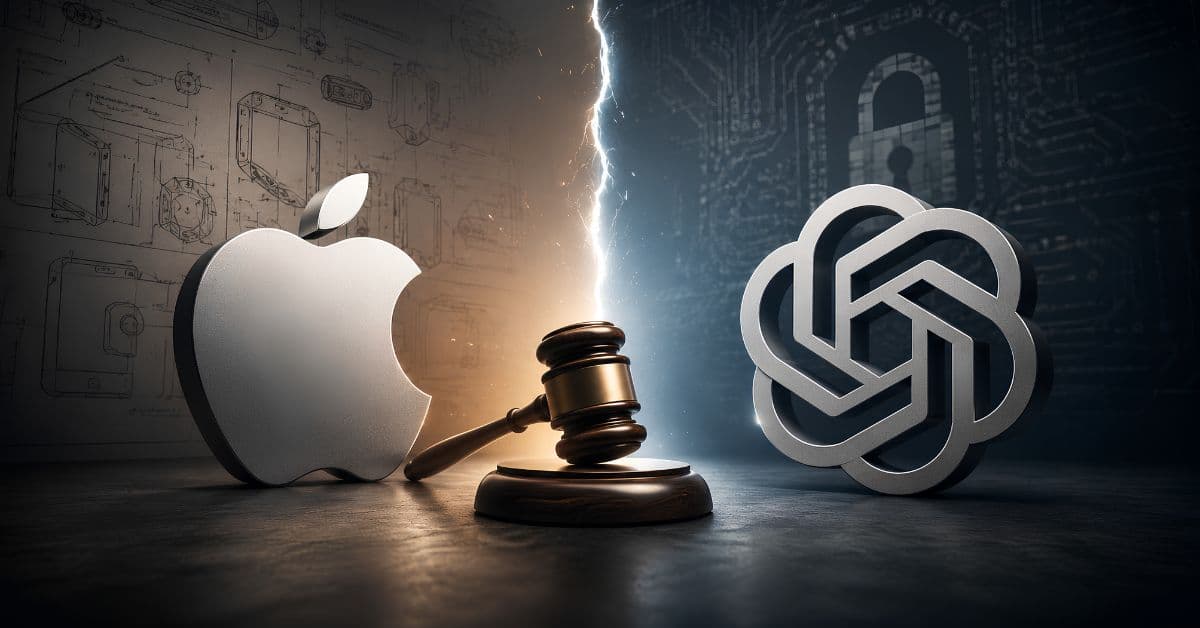
Apple has filed a lawsuit against OpenAI, alleging the company misappropriated trade secrets and confidential information while expanding its AI hardware business.
The lawsuit, filed in the U.S. District Court for the Northern District of California, claims OpenAI benefited from confidential Apple information obtained through former employees who later became involved in its AI hardware efforts.
OpenAI has denied the allegations, stating that it has “no interest in other companies’ trade secrets” and remains focused on developing its own technology.
Apple says former employees shared confidential information
According to the complaint, Apple alleges that former executive Tang Tan and former engineer Chang Liu played key roles in the alleged misuse of confidential company information after leaving Apple.
Apple claims Tan encouraged Apple employees interviewing with OpenAI to discuss unreleased products, engineering work, manufacturing processes, supplier relationships, and other confidential projects. The lawsuit also alleges that some candidates were asked to bring hardware components to interviews.
The complaint further claims that Liu continued accessing confidential Apple information after leaving the company and continued receiving internal updates from an Apple employee.
Apple says its internal investigation uncovered what it describes as a broader pattern involving multiple former employees who later joined OpenAI. According to the company, this allowed confidential information to influence OpenAI’s AI hardware development.
Apple seeks damages and other remedies
Apple is asking the court to prohibit OpenAI from using or possessing any confidential Apple technology allegedly obtained through the misconduct.
The company is also seeking an order requiring OpenAI to destroy any proprietary Apple materials in its possession, redesign products that allegedly rely on Apple’s trade secrets if necessary, and pay damages, with the final amount to be determined at trial.
The lawsuit also names Tang Tan and Chang Liu as defendants, alleging they violated confidentiality agreements signed during their employment at Apple.
OpenAI has rejected Apple’s allegations, saying it does not rely on competitors’ confidential information and has no interest in acquiring trade secrets.
Apple says it attempted to resolve the dispute privately earlier this year but received no response, prompting the company to file the lawsuit.
The case will now move through the U.S. court system, where both sides will have the opportunity to present evidence supporting their respective claims.
As with any ongoing litigation, the allegations in Apple’s complaint have not been proven in court, and the outcome will depend on future legal proceedings.
Do you think lawsuits over AI talent and trade secrets will become more common as companies continue investing in AI hardware? Let us know in the comments below.