

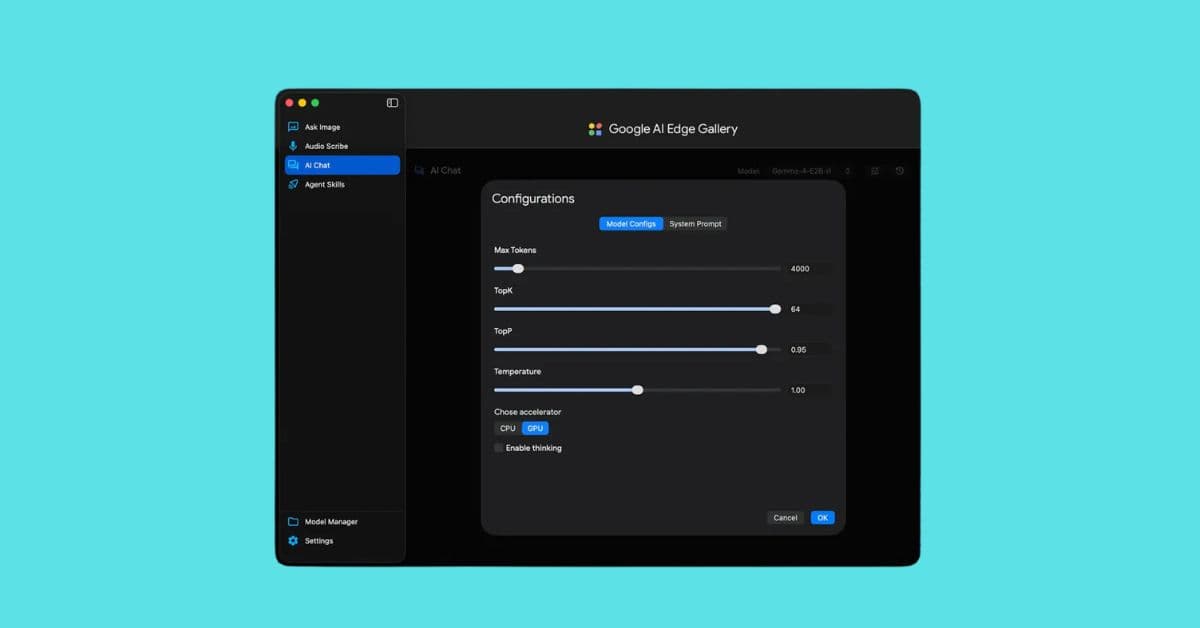
Google has expanded its on-device AI efforts on the Mac with three major announcements: a macOS version of Google AI Edge Gallery, the new Gemma 4 12B model, and the Google AI Edge Eloquent dictation app.
Google brings AI Edge Gallery to the Mac
While services like OpenAI’s ChatGPT, Anthropic’s Claude, and Google’s Gemini run on remote servers, local AI models run directly on a user’s computer.
Running models locally offers several advantages. Local models can work without an internet connection, keep data stored on the device, and take advantage of a computer’s own hardware for processing.
Google’s AI Edge Gallery, which was previously available on iPhone and Android, is now available for macOS. Unlike Ollama and LM Studio, which support models from multiple developers, AI Edge Gallery currently focuses on Google’s own Gemma family of models.
The available models include:
- Gemma-4-12B-it
- Gemma-4-E2B-it
- Gemma-4-E4B-it
- Gemma-3n-E2B-it
- Gemma-3n-E4B-it
Gemma 4 12B aims to bring larger AI capabilities to consumer hardware
The biggest announcement is the launch of Gemma 4 12B.
Google says the model was designed to deliver agentic and multimodal capabilities directly on consumer hardware. According to the company, Gemma 4 12B delivers performance comparable to some much larger AI models while remaining compact enough to run on laptops with 16GB of RAM.
The model supports text, image, and audio inputs, allowing it to handle a broader range of tasks beyond text-only workloads.
Google also highlighted coding and data analysis capabilities as key use cases for the model.
Google also launched a new Mac dictation app
The company also unveiled AI Edge Eloquent, an on-device dictation app that can transcribe speech and automatically improve readability by removing filler words and making light edits.
Users can also choose different writing styles and add custom words, names, and industry-specific terminology to improve transcription accuracy.
Because all processing happens locally, users do not need to send recordings or transcripts to Google’s servers, which could appeal to users who prioritize privacy and offline functionality.
Would you use local AI models on your Mac, or do cloud-based tools like ChatGPT and Claude already meet your needs? Share your thoughts in the comments below.
You may like to read: 7 best NotebookLM alternatives tools