
Apple is loosening a Mac App Store rule that has kept universal macOS apps compatible with Intel Macs. A September 1 developer notice, first reported by MacRumors, says universal Mac App Store apps that require macOS 13 or later can now remove Intel support and ship future updates as arm64-only.
This is an optional change for developers, not a shutdown of the Mac App Store on Intel hardware. Apple’s separate developer update on Rosetta confirms the wider move away from Intel code, but it does not say that every Mac App Store app must drop Intel support immediately.
Which apps are covered
Apple’s wording applies to a specific group of apps:
- A universal macOS app with both Intel and Apple silicon code.
- An app distributed through the Mac App Store.
- An app whose minimum requirement is macOS 13 or later.
- A future update in which the developer chooses to remove the Intel build.
The notice does not name any apps, and it does not set a date when all Mac App Store developers must make the switch. Developers can submit an arm64-only build to simplify development and reduce the app’s download and on-device size.
That also means an app with a minimum requirement below macOS 13 is not covered by this specific wording. The same is true for apps that developers leave as universal builds. The change is about Mac App Store submissions, not a new requirement for every app distributed on macOS.
What happens to Intel Macs
If a developer submits an arm64-only update, an Intel Mac will stay on the last version that supports its processor and will not receive later updates for that app. MacRumors reports that Intel users can continue using that last compatible version, but a specific app’s future support and redownload options remain up to its developer.
Apple has already set the larger hardware limit. macOS 26 Tahoe is the last macOS release with full Intel support, while macOS 27 Golden Gate supports Apple silicon Macs only. Apple says macOS 27 will ship this fall. The macOS 27 compatibility list shows which newer Macs can make the jump, and the macOS 26 Tahoe list helps Intel Mac owners check whether Tahoe is their final major release.
Intel Macs will not suddenly stop working. Apple’s deployment documentation says the company will continue providing software security updates for Intel-based Mac computers for three years. That does not guarantee new features or ongoing updates for every third-party app, so keeping the current compatible app version may become increasingly important.
Apple silicon users face a separate app deadline
The Rosetta part of this transition affects Apple silicon Macs running Intel-only apps. Apple says macOS 26.4 and later may show a warning when one of those apps launches. macOS 27 is the last release with general-purpose Rosetta support, so Intel-only Mac apps will not run on Apple silicon after that release. Apple plans to keep a limited Rosetta subset for older, unmaintained games.
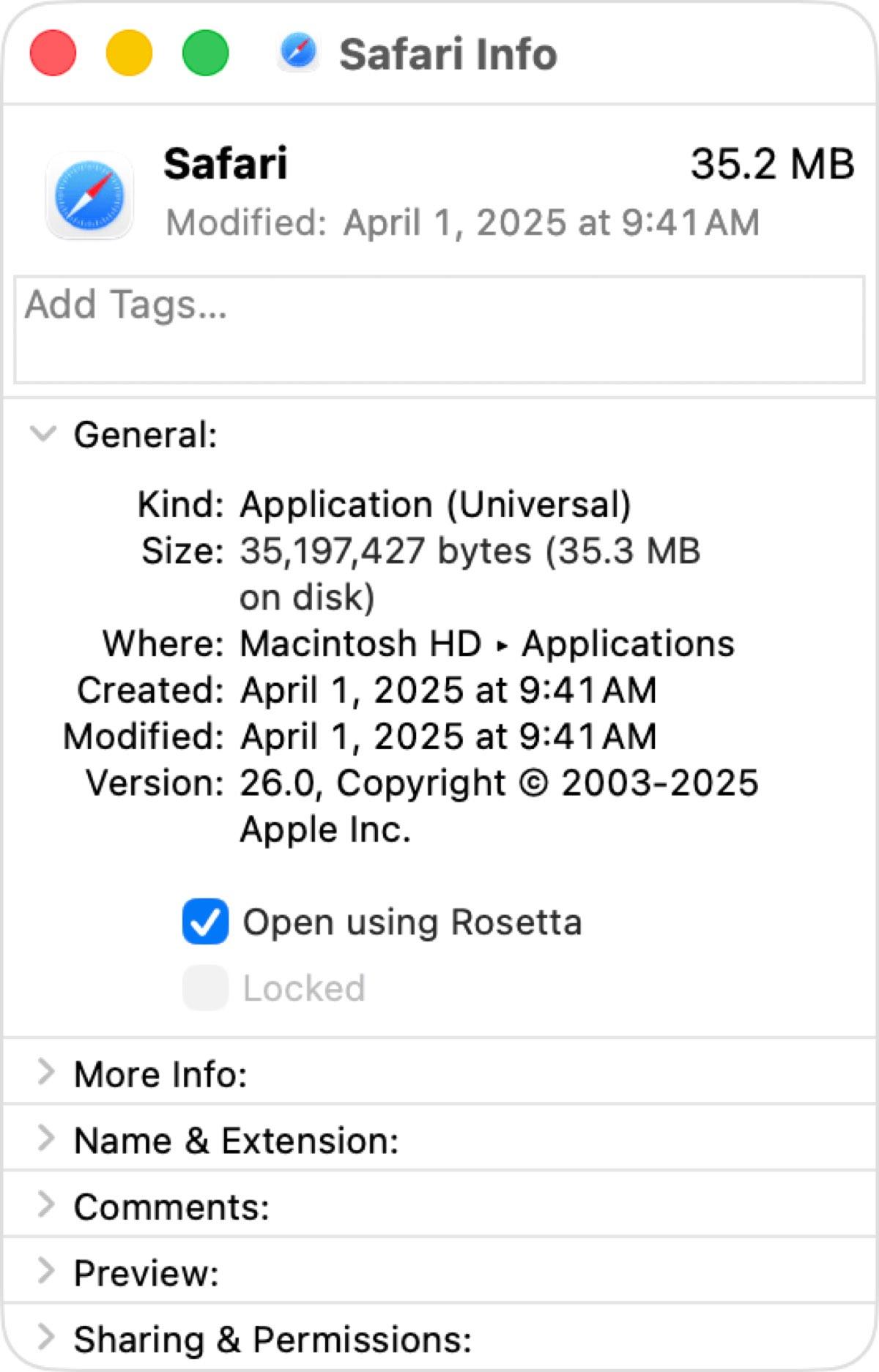
If you use an Apple silicon Mac, select an app in Finder, press Command-I, and check the “Kind” field. “Application (Intel)” means the app still relies on Rosetta. “Application (Universal)” and “Application (Apple silicon)” are ready for the newer architecture. Apple recommends looking for an update in the App Store or on the developer’s website.
For Intel Mac owners, the practical change is app by app. The Mac App Store remains available, macOS 26 remains the last major system release, and developers can now decide when an eligible app leaves Intel behind.