

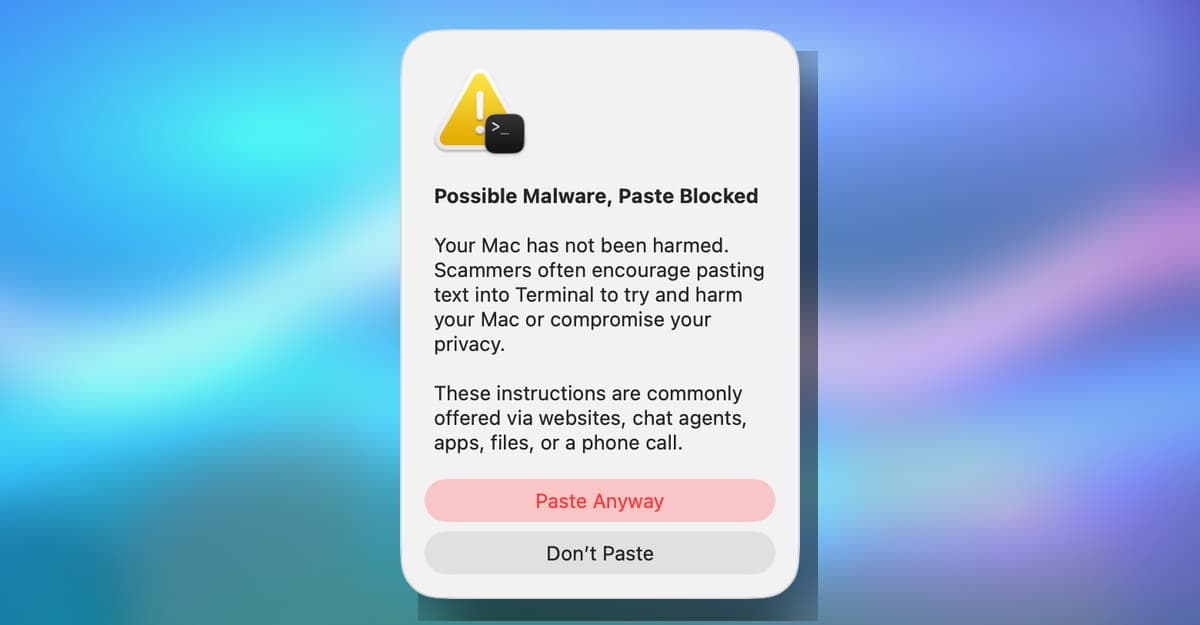
Apple has published a new support document explaining why macOS may block a command pasted into Terminal, giving users a clearer idea of when the alert is a simple caution and when macOS has detected known malware.
The warning is aimed at a common scam pattern: someone tells a Mac user to copy a command from a website, chat agent, messaging app, or email and paste it into Terminal. That can be risky because Terminal commands can change settings, download files, run scripts, or expose private data if the user does not know what the command does.
The alert is mainly for infrequent Terminal users
Apple says the “Possible malware, Paste blocked” alert can appear if you do not regularly use Terminal and copied the command from places such as the web, a chat agent, messages, or email.
That distinction matters. A Mac user following a trusted guide may occasionally need Terminal for legitimate tasks, such as creating a bootable macOS USB installer. Apple’s alert is meant to slow down risky copy-paste behavior, not declare every Terminal command dangerous.
If you see this possible-malware warning, Apple says your Mac has not already been harmed. You should not paste the command unless you are sure what it does and trust where it came from. If you are certain, macOS can still let you choose Paste Anyway.
Known malware gets a stronger block
Apple also explains a separate case: “Malware Detected, Paste Blocked” or “Malicious Script Blocked.” These alerts appear when macOS detects known malware in a command or script.
In that situation, the advice is simpler: do not paste the command or run the script. Apple also points users to its website review page if they think the block happened because a website was wrongly reported as deceptive.
The timing is useful because Terminal is no longer a tool only advanced Mac users touch. Setup guides, AI chatbots, support threads, and troubleshooting pages often suggest commands. Apple’s new explanation makes the boundary clearer: Terminal is fine when you understand and trust the command, but copying random text into it remains one of the fastest ways to hurt your Mac.