


OpenAI has officially launched GPT-6 Astra, its new flagship model for computer use, coding, browsing, science, and professional work. The rollout starts with a limited set of organizations before expanding to ChatGPT Plus, Pro, Business, and Enterprise users over the next few days.
The most useful changes are aimed at long, messy tasks. ChatGPT can work through more steps on a computer, while Codex can keep track of earlier context instead of relying only on a compressed summary when a session runs long.
Astra is built to work across a computer
OpenAI says Astra can fill out forms, update customer records, organize calendars, research online, edit documents, build spreadsheets and presentations, create websites, and run frontend checks. These are OpenAI’s stated capabilities and examples, not independent test results.
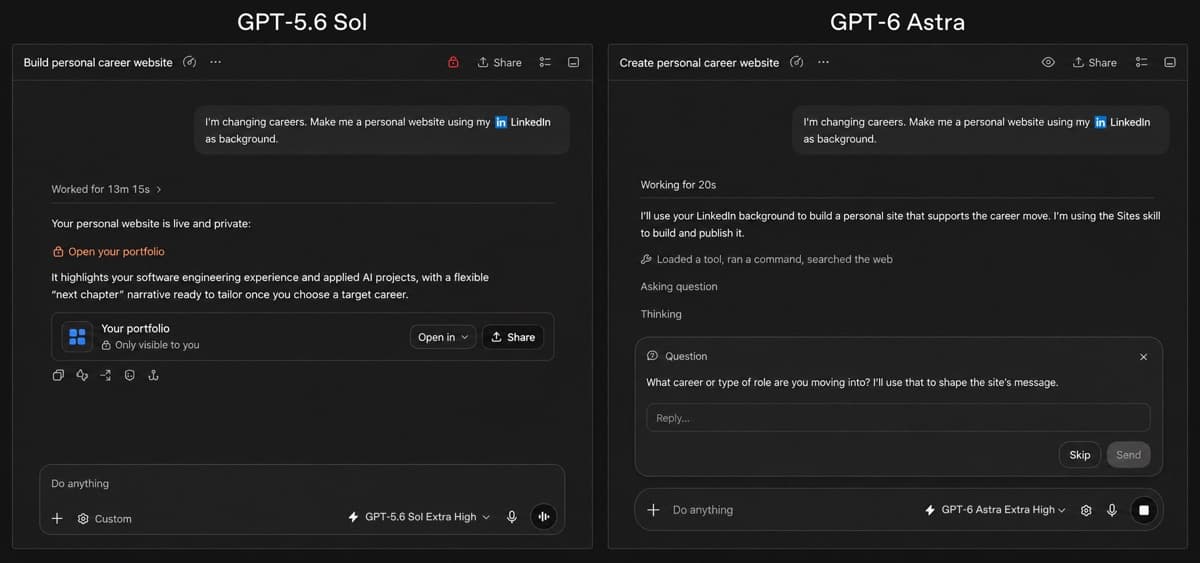
The company reports a 72.6% score for Astra on OSWorld 2.0, compared with 65.7% for GPT-5.6 Sol. OpenAI also says Astra completed the simulated tasks in about 40 minutes, versus about 75 minutes for Sol. That works out to roughly 47% less time per task in the company’s test.
OpenAI has updated the Codex harness alongside the model. On the Mind2Web benchmark, it says Astra and the new harness completed tasks 1.9 times faster than the current GPT-5.6 Sol experience. The combination matters because computer-use models spend a lot of time reading screens, deciding what to click, and recovering from small changes in an interface.
The focus follows the recent GPT-5.5 upgrade for ChatGPT and Codex, which pushed OpenAI’s coding tools toward longer tasks that include investigation, testing, and revision.
Codex can search earlier context windows
Codex is getting a more specific context feature with Astra. When a long session fills its context window, Astra can keep notes across windows instead of repeatedly reducing the work to one summary. Earlier context windows also remain searchable, so Codex can retrieve a requirement, failed test, or tool result that did not make it into the notes.
That should help with large refactors and difficult debugging sessions, where the reason behind a failed fix can be as important as the fix itself. OpenAI says the feature is experimental now. Users can enable it in Codex, and it will become the default for Astra in the coming weeks.
It also fits the way OpenAI has been spreading Codex across devices. The Codex experience on iPhone and Android lets users check work and steer a session away from the computer, while Astra is aimed at keeping the session coherent when the work itself gets longer.
The rollout is gradual because Astra is more capable
OpenAI says Astra is its first model to reach the Critical level of cybersecurity capability under its Preparedness Framework. Its safety overview says the model can find unknown security flaws and develop exploits with the right tools and access, so the company has added stronger safeguards and broad misalignment monitoring.
The model is also being tested against prompt injection and destructive computer actions such as unauthorized transactions, data loss, or excessive access. If the monitoring system detects a possible problem, ChatGPT or Codex may pause or stop the task so the user can review it.
That extra friction is part of the launch. Astra may be better at operating a computer, but it is also being given more ways to affect the user’s files, accounts, and browser sessions.
When GPT-6 Astra will be available
OpenAI says Astra is rolling out first to a limited set of organizations. Plus, Pro, Business, and Enterprise users are next, with access also coming to the OpenAI API, Microsoft Azure, and AWS Bedrock. Enterprise administrators must enable it, and access is off by default at launch.
Developers can use the gpt-6-astra model ID. OpenAI lists standard API pricing at $10 per million input tokens and $50 per million output tokens. Fast mode can run at up to twice the speed for twice the standard price.
The ChatGPT app on Mac remains the most natural place to see the computer-use side of Astra, but access will depend on the account, plan, and rollout stage. For now, GPT-6 Astra is a controlled release of a more capable agent, not an instant replacement for every ChatGPT model.