
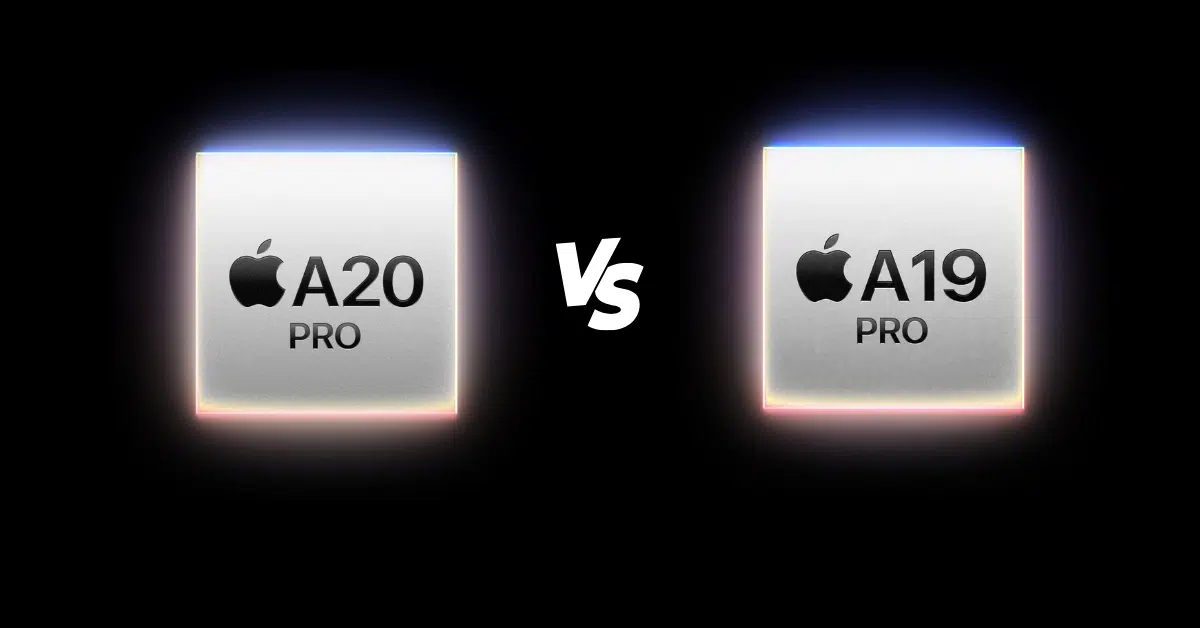
I have come to a stage where Apple’s yearly chip upgrades are difficult to judge by the name alone. An A20 Pro seems like a straightforward successor to the A19 Pro, but once I got to know about the actual improvements, I realised Apple has got much more under the hood.
The A20 Pro is the first 2nm iPhone chip, featuring a 7-core GPU, wide memory bandwidth, a dual Neural Engine, and new CPU cores. This makes it one of the greatest improvements Apple has made to its mobile silicon in recent times.
So, how big is the change that you will experience? I have analysed the A20 Pro vs A19 Pro across performance, gaming, AI, memory, efficiency, and thermal performance to see what has really changed and whether the A20 Pro is a good enough reason to upgrade to the iPhone 18 Pro.
A20 Pro vs A19 Pro: Specs at a glance
Before getting into the interesting stuff, here’s how the two Apple Silicon generations compare.
| Specification | A20 Pro | A19 Pro |
|---|---|---|
| Process | TSMC 2nm (N2) | TSMC 3nm (N3P) |
| CPU | 6-core | 6-core |
| CPU configuration | 2 Super + 4 efficiency cores | 2 performance + 4 efficiency cores |
| Peak CPU clock | Up to 4.93GHz | Up to 4.26GHz |
| GPU | 7-core | 6-core |
| Neural Engine | Dual 16-core / 32 cores | 16-core |
| Memory | 12GB LPDDR5X | 12GB LPDDR5X |
| Memory interface | 96-bit | 64-bit |
The interesting part is that Apple didn’t simply increase the CPU core count. Both chips have six CPU cores. However, in order to improve performance, Apple decided to redesign the CPU cores, push up clock speeds, and redesign many elements around them.
And that is only the beginning.
2nm vs 3nm: The biggest A20 Pro upgrade
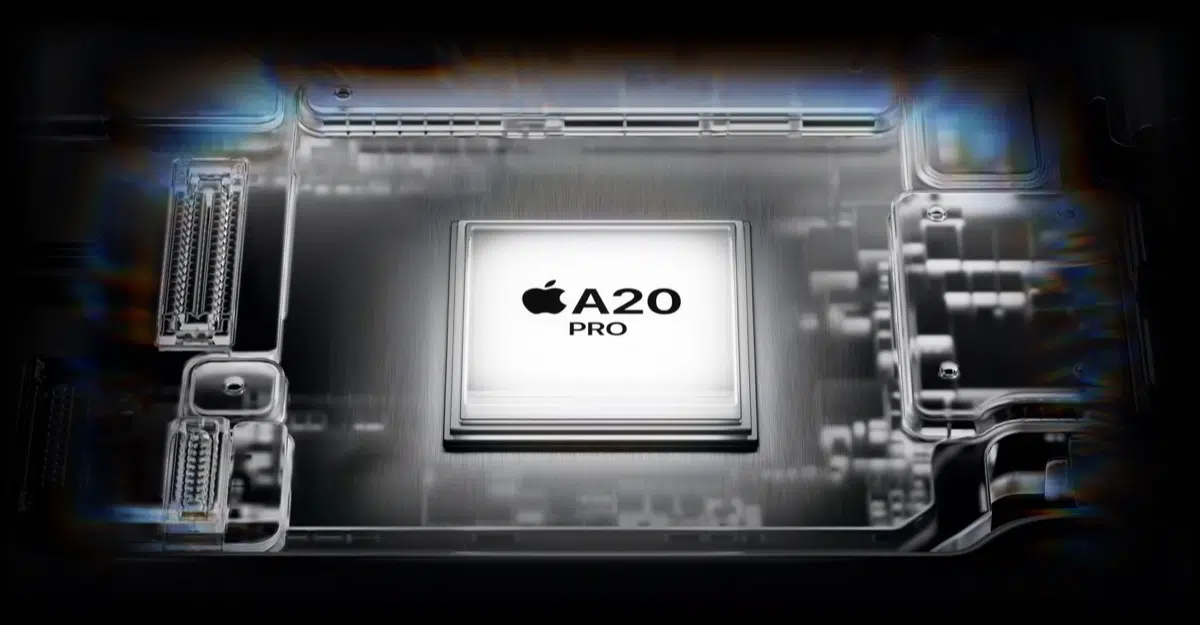
When it comes to choosing just one upgrade for the A20 Pro, then it has to be the move from 3nm to 2nm.
The A19 Pro was manufactured using a 3nm-class process, while the A20 Pro moves to TSMC’s N2 2nm process. This lets Apple fit more transistors into a similar die area while providing 18% faster performance and 30% lower power consumption, compared to the A19 Pro.
Besides that, M-class packaging design puts memory and the silicon die in a side-by-side position. This leads to an improvement in the heat dissipation capabilities of the A20 Pro.
Why does 2nm matter on an iPhone?
This is because smartphone CPUs have an inconvenient challenge: They require desktop-level performance without desktop-class cooling.
I can mount a huge cooler on a desktop processor. Apple won’t be able to put it into their iPhone. That’s why efficiency is so important.
The A20 Pro’s 2nm foundation gives Apple more room to increase performance without increasing power draw and overheating. And Apple has used that extra headroom across the CPU, GPU, memory subsystem, and AI hardware. Ultimately, you get better battery life and speed.
CPU performance: How much faster is it?
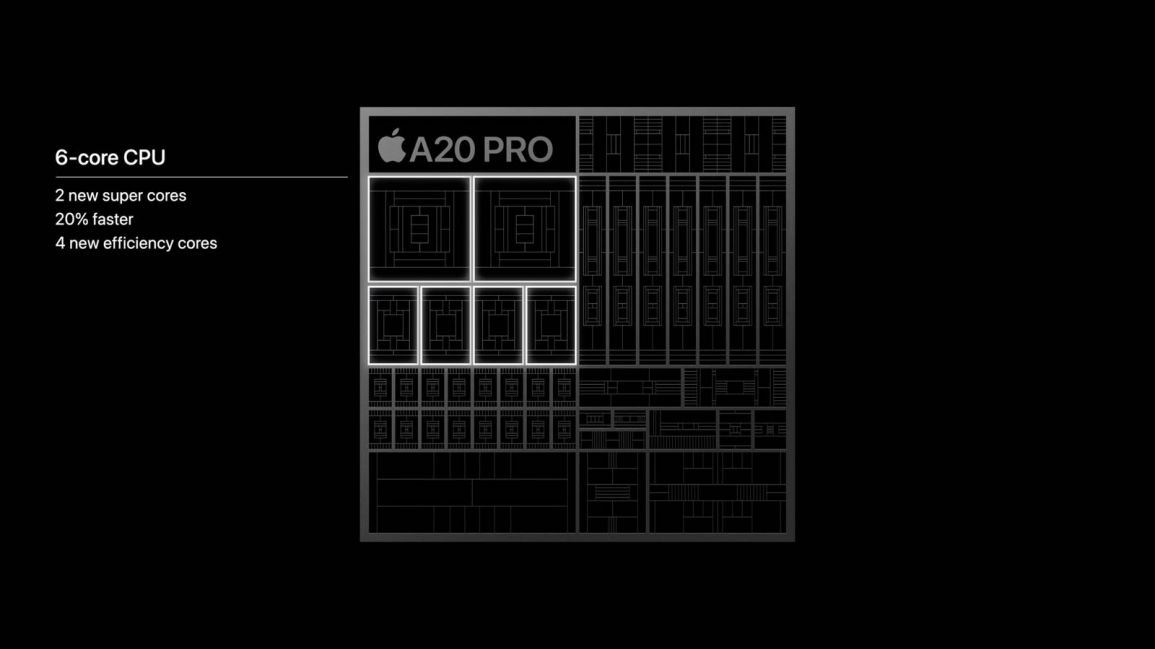
The A20 Pro retains a six-core CPU, but Apple has introduced two new Super cores and four new efficiency cores. The Super cores can reach up to 4.93GHz, compared with roughly 4.26GHz on the A19 Pro’s Everest performance cores. Apple describes the new cores as desktop-class and says they are up to 20% faster.
And the benchmark numbers back up the idea that this isn’t a minor CPU refresh.
A20 Pro vs A19 Pro: Benchmark Comparison
| Benchmark | A20 Pro | A19 Pro |
|---|---|---|
| Geekbench 6 Single-Core | 4,719 | 3,895 |
| Geekbench 6 Multi-Core | 12,677 | 9,746 |
| Geekbench 7 Single-Core | 4,006 | 3,249 |
| Geekbench 7 Multi-Core | 11,460 | 9,016 |
| AnTuTu 11 | 2,935,466 | 2,538,751 |
An early Geekbench 7 result represented improvements of about 23.3% in single-core and 27.1% in multi-core in that particular comparison.
The A20 Pro also has a clear edge over Qualcomm’s Snapdragon 8 Elite Gen 5 in CPU performance, particularly in single-core workloads. In Geekbench 6, the latter typically scores around 3,588 and 10,207, respectively. That puts Apple ahead by roughly 50% in single-core and 29% in multi-core, according to these reported results.
What about real-world performance?
Having owned an A19 Pro iPhone before, I would not expect the A20 Pro to instantly give me a 25% improvement in basic operations. The A19 Pro is already very fast.
But the difference will be much more noticeable if the workload makes the CPU work for a longer period of time:
- Video editing
- Photo processing
- 3D applications
- AI workloads
- Gaming
- Large file processing
- Heavy multitasking
So yes, the A20 Pro CPU performance has improved substantially. But I think that the more interesting part is how Apple will use the additional performance over a longer period.
GPU and gaming performance
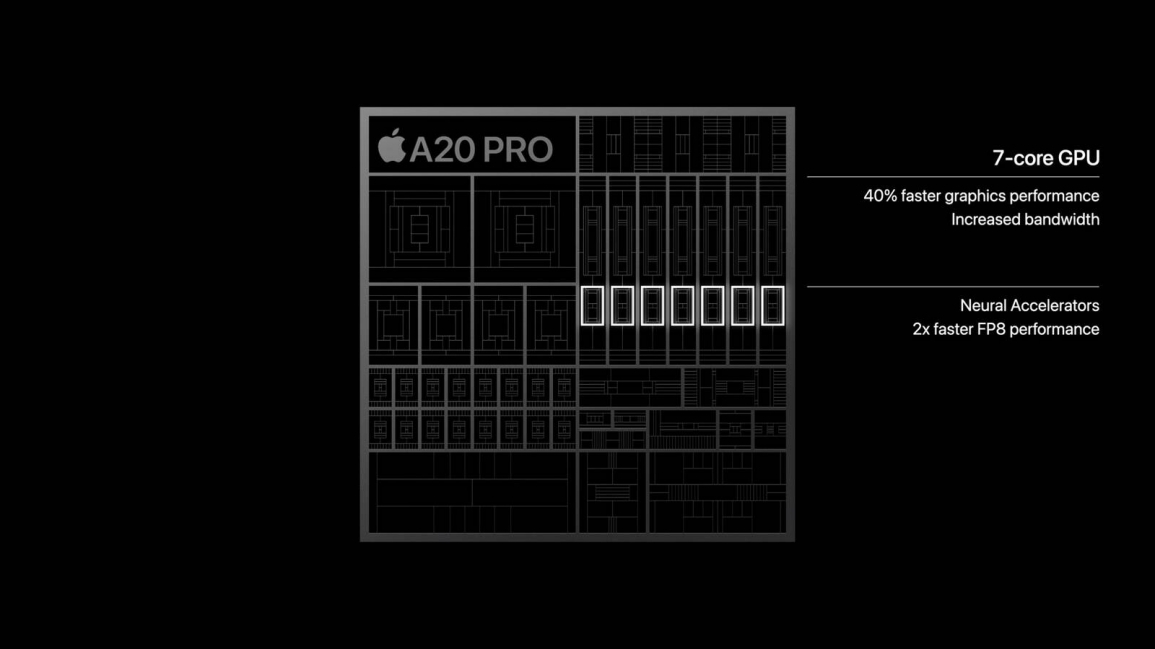
The A19 Pro has already received a major GPU upgrade, with Neural Accelerators built into each GPU core and a larger 32 MB cache. This improved hardware ray tracing and graphics performance and enabled direct handling of complex on-device AI workloads.
The A20 Pro gets a meaningful graphics upgrade on this.
Apple has moved from the A19 Pro’s 6-core GPU to a 7-core GPU. The new GPU also includes Neural Accelerators designed to accelerate AI-related workloads, while Apple claims the A20 Pro delivers up to 40% faster graphics performance than the A19 Pro.
This makes the A20 Pro very appealing for gaming purposes.
But I wouldn’t judge the GPU upgrade solely by a short benchmark. A smartphone can render a very high frame rate for just a few minutes, after which it starts to struggle because of overheating. This is why I believe the A20 Pro’s GPU update looks even more exciting when combined with its thermal architecture.
For demanding games, the improvements should matter most in:
- Higher and more stable frame rates
- Better ray-tracing performance
- More demanding graphics settings
- Longer gaming sessions
- Reduced performance degradation from heat
- Better handling of graphics-heavy AI features
Early Geekbench graphics results also show a performance gain of approximately 38-40% for the A20 Pro’s full 7-core GPU, although such tests shouldn’t be considered a general benchmark of gaming performance.
If I were buying an iPhone to play demanding games, I’d pick the A20 Pro without any doubts. Though the A19 Pro itself has some good capabilities, its successor has more graphics hardware and sustainability.
Memory: A20 Pro gets a wider highway
This is probably the A20 Pro upgrade that most people will overlook. Both generations can have 12GB of LPDDR5X-9600 memory; hence, the impression is that there is not much change from the earlier version.
But the memory interface is wider. The A19 Pro uses a 64-bit memory interface, reaching up to 76.8 Gb/s bandwidth. The A20 Pro reportedly moves to a 96-bit interface, thus supporting 115.2 Gb/s memory bandwidth, which is 50% better.
I like to think of memory bandwidth as a highway. The amount of RAM is roughly how much cargo I can keep available, whereas Memory bandwidth is how quickly I can move that cargo around. Adding more lanes becomes useful when I start moving huge amounts of data, especially for GPU, AI, and graphics workloads.
That’s why this upgrade matters for:
- AI processing
- Graphics rendering
- Gaming
- Video editing
- Large image processing
- Multitasking
- On-device machine learning
And it helps explain why Apple can improve performance without simply throwing more CPU cores into the chip.
Neural Engine and AI performance
AI is no longer just an additional feature at Apple, and the A20 Pro is a clear example of this.
While the A19 Pro features a 16-core Neural Engine, the A20 Pro comes with two Neural Engines, which results in 32 Neural Engine cores. Moreover, the A20 Pro has Neural Accelerators in the GPU system.
According to Apple, these Neural Accelerators will provide 2x faster performance in FP8 operations. This matters because Apple is now focusing more on executing AI on the device itself.
Instead of sending every AI request to a cloud server, more processing can happen locally using Apple’s new Foundation Models. That can improve responsiveness and privacy while reducing the need for a constant internet connection.
The A20 Pro’s AI hardware should therefore be useful for:
- Apple Intelligence
- Generative AI
- Image generation
- AI-assisted photo editing
- Voice processing
- On-device language models
- Real-time image and video processing
In my view, it looks like the A20 Pro has been built to handle not only the Apple Intelligence features the current iPhone has, but also future features Apple might want to introduce.
Thermal performance: Where A20 Pro could make the biggest real-world difference
This is my favourite A20 Pro upgrade because it addresses a genuine problem: heat.
The A20 Pro also changes how Apple packages the chip for sustained performance. Unlike past Apple processors, which used PoP (Package-On-Package), the A20 Pro will have WMCM (Wafer-Level Multi-Chip Module) packaging, placing the memory beside the main chip instead.
This will make sure that the heat can now have a clear route out of the CPU and GPU and not get trapped around the hottest part of the chip. In practice, that should help the A20 Pro reduce thermal throttling and maintain higher performance for longer.
Apart from that, Apple has also upgraded the iPhone 18 Pro by including a vapour chamber three times the size of its predecessor. The wider surface area distributes heat and helps it dissipate faster. With all of these, the A20 Pro is able to give 40% better sustained performance compared to the A19 Pro.
This could benefit:
- Long gaming sessions
- 4K and high-resolution video editing
- ProRes workflows
- 3D rendering
- AI processing
- Photography processing
- Other sustained workloads
And this is where I think the A20 Pro could feel more different from the A19 Pro than the raw benchmark numbers suggest.
Modem and connectivity improvements
The A20 Pro generation also changes what’s happening beyond the processor itself.
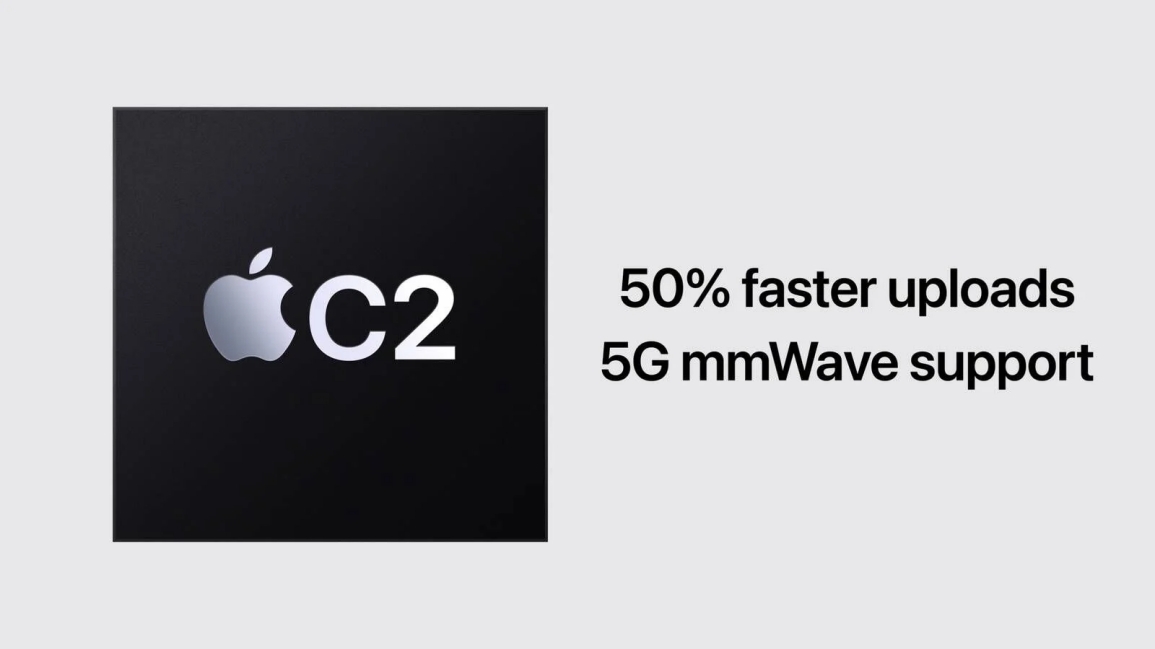
The iPhone 18 Pro generation introduces Apple’s C2 modem to the Pro lineup, replacing the Snapdragon X80 modem used in the previous Pro generation. According to Apple, the C2 is capable of delivering 50% faster uploads and 15% lower power consumption and uses mmWave 5G (only in the USA).
The A20 Pro generation also continues Apple’s move toward in-house connectivity hardware. The N1 wireless chip handles technologies including Wi-Fi 7, Bluetooth 6 and Thread.
For me, the important part isn’t simply that Apple has replaced one modem with another. It’s the possibility of tighter integration of Apple’s own silicon for better power consumption, connectivity, and system-level performance.
A20 Pro vs A19 Pro: Should you upgrade to the iPhone 18 Pro?
After analysing all the aspects, it was clear that the A20 Pro is really a great upgrade.
However, this does not necessarily mean everyone owning an A19 Pro must go out and get an iPhone 18 Pro. If you already own an iPhone 17 Pro or iPhone 17 Pro Max, I wouldn’t upgrade just for everyday speed.
The A19 Pro is already ridiculously fast. If you utilise your iPhone 18 Pro primarily for messaging, web-browsing, social media interaction, photography, and media streaming, you will hardly notice any difference.
I’d consider the upgrade much more seriously if I:
- Play demanding games regularly
- Edit videos on my iPhone
- Use AI-intensive features
- Want the best possible graphics performance
- Keep my iPhone for four or five years
- Care about sustained performance
- Want Apple’s latest modem and connectivity hardware
For someone buying a new Pro iPhone anyway, though, I’d take the A20 Pro over the A19 Pro every time.
Final thoughts
The A20 Pro is more than just a faster version of the A19 Pro. Apple has practically upgraded every single aspect of the performance equation. Here you have 2nm process, new CPU architecture, larger GPU, increased memory bandwidth, improved AI architecture, and even better thermal management.
For me, the biggest advantage is that Apple isn’t just chasing higher peak performance; it is trying to keep the A20 Pro running fast for longer and able to sustain it.
Is the A20 Pro’s extra power enough to make you upgrade to the iPhone 18 Pro? Let me know in the comments below!