
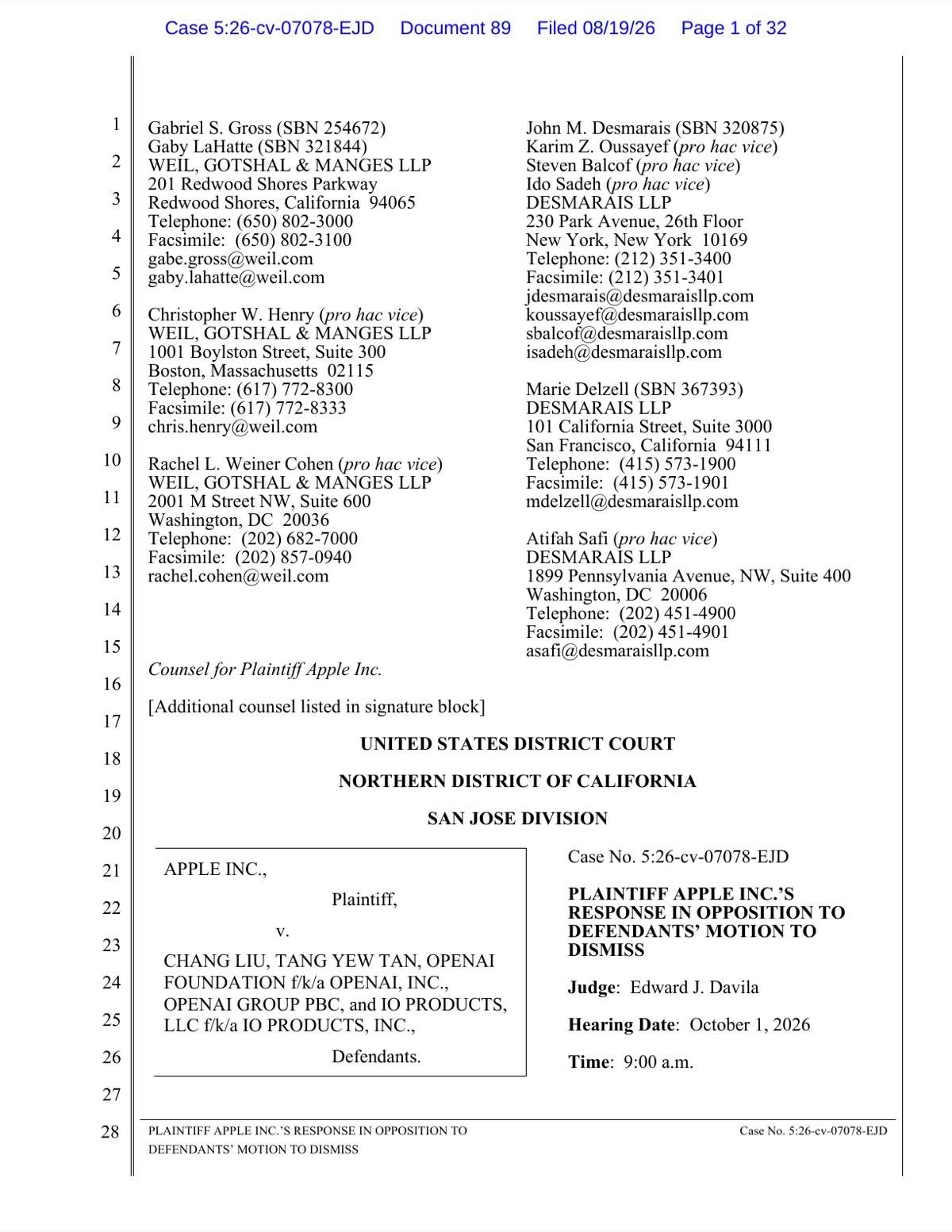
Apple is asking a federal judge to keep its trade secret case against OpenAI alive. In an opposition filed on August 19 in federal court in San Jose, Apple says OpenAI’s motion to dismiss “relies on distortion, speculation, and improper extrinsic evidence” and asks the court to deny it in full.
The filing answers the motion OpenAI, io Products, and former Apple employees Chang Liu and Tang Tan filed on August 5. That motion called Apple’s July lawsuit meritless and asked the court to end the case before discovery begins.
Apple repeats its core allegations
Apple’s response revisits the allegations in its original complaint. It says Liu, a senior system electrical engineer who spent eight years at Apple, exploited an authentication bug to access Apple’s confidential network repository for weeks after joining OpenAI. Apple alleges that he downloaded dozens of engineering files, including a presentation on how Apple builds and tests its main logic boards, and reacted to his own access in writing with “LOL … so funny.”
The filing also alleges that Tan, now OpenAI’s chief hardware officer, used Apple’s internal project codenames to quiz job candidates about unreleased products. Apple says he asked a then-current employee to bring “some parts” she worked on, including batteries and logic boards, to interviews for “show and tell.”
Apple also accuses OpenAI and io Products of building the behavior into their hiring process: structuring interviews to pull out engineering and supplier details, encouraging candidates to bring prototypes and CAD files, coaching new hires to dodge Apple’s exit procedures, and getting one of Apple’s manufacturing partners to perform a proprietary metal-finishing technique on OpenAI products.
Apple challenges OpenAI’s defenses
OpenAI’s motion says Apple never identified real trade secrets, showed actual misappropriation, or explained how it was harmed. It portrays Liu as an ex-employee helping a former colleague at an Apple manager’s request, and says Tan kept an Apple offboarding document for legitimate compliance reasons.
Apple’s answer to the Liu defense is the sharpest line in the filing: “A manager’s transition question is not authorization to raid Apple’s confidential repository.” It adds that the defendants cite nothing suggesting anyone at Apple knew about or approved the downloads.
Apple also objects to how OpenAI built its motion, saying the company leaned on outside messages, third-party websites, and attorney claims about Apple’s security practices. That kind of extrinsic evidence, Apple argues, has no place at the dismissal stage, where the court must accept the complaint’s allegations as true.
OpenAI’s public response remains firm. In a blog post titled “Apple is getting this wrong,” the company says it does not have and does not want any Apple trade secrets, and calls the lawsuit “careless, aggressive and oddly personal.”
What happens next
OpenAI’s reply is due August 26, and Judge Edward J. Davila hears arguments on the motion to dismiss on October 1 in San Jose. Apple’s separate push for a preliminary injunction, which could restrict OpenAI’s hardware work while the case plays out, runs on its own schedule: opposition briefs are due August 31, with replies by September 14.
If the motion fails, OpenAI faces discovery into its hardware program as it works toward its first devices. If it succeeds, Apple may get a chance to amend its complaint, a possibility Apple’s filing acknowledges.