

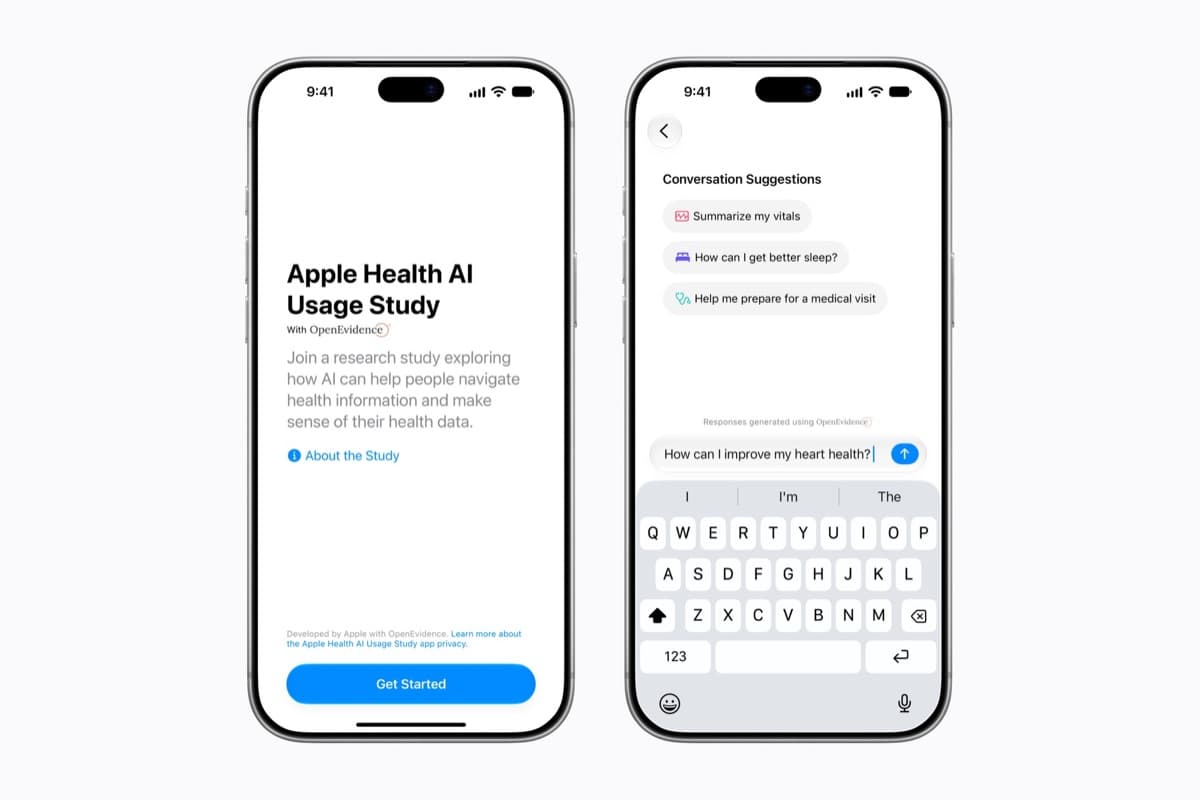
Apple has launched the Apple Health AI Usage Study in the United States. Apple announced it on November 15, 2026. The virtual study comes with a companion study app, which Apple developed with OpenEvidence, and it tests how people use AI for health questions.
The study is open to up to 200,000 eligible participants across the United States. Apple does not say how long it will run.
Joining requires an adult age and a supported iPhone
Participants must be 21 or older. They need an Apple Intelligence-enabled iPhone, meaning an iPhone 15 Pro or later, running iOS 26 or later.
The study app, called Apple Health AI Study App, is free on the U.S. App Store. It works only on iPhone and requires iOS 26.0 or later.
The gate here is an age limit and a phone. OpenEvidence’s own App Store app is available only to healthcare professionals, so the study’s bar is far lower.
Sharing is optional. The app uses only the Apple Health data you choose to share, such as resting heart rate, activity, sleep, or lab results. Participants keep control over whether to share HealthKit metrics or survey responses.
Study data will not be used to train AI models, and Apple applies security measures to the study data it maintains. Still, the App Store privacy label says a User ID is linked to the user and used for analytics and app functionality. Performance diagnostics are not linked to the user.
ChatGPT can already connect to Apple Health data for logged-in U.S. users who are 18 or older. That came with the Health in ChatGPT rollout in July 2026.
In 2025, Bloomberg reported that Apple was working on a Health+ service with an AI coach for the Health app, expected to launch in 2026. In February 2026, Bloomberg reported that Apple had scaled back those plans and would release some of the features one at a time instead.
Health AI answers can be incomplete or unclear, so take them to a doctor
In the study app, participants can ask everyday health questions and get complex medical information explained in plainer language. Each answer comes with linked citations to peer-reviewed sources. The app flags certain concerning questions and recommends contacting a clinician or other support.
Apple says LLM-based consumer health tools “may at times offer responses that are incomplete or unclear.” That is a fair warning, and it is the reason to take any answer to a doctor before acting on it.
The study looks at what drives user trust, the quality of responses, comprehension, and everyday health actions. It also looks at whether health AI can help participants prepare for visits with their own doctors.
The app is not meant to diagnose or treat any condition, or to replace medical advice. Participants should talk to a doctor or clinician about health concerns, including any medical information the app gives them.
Before you install, read the eligibility rules and the privacy label, and share only the Health data you are comfortable sharing.