
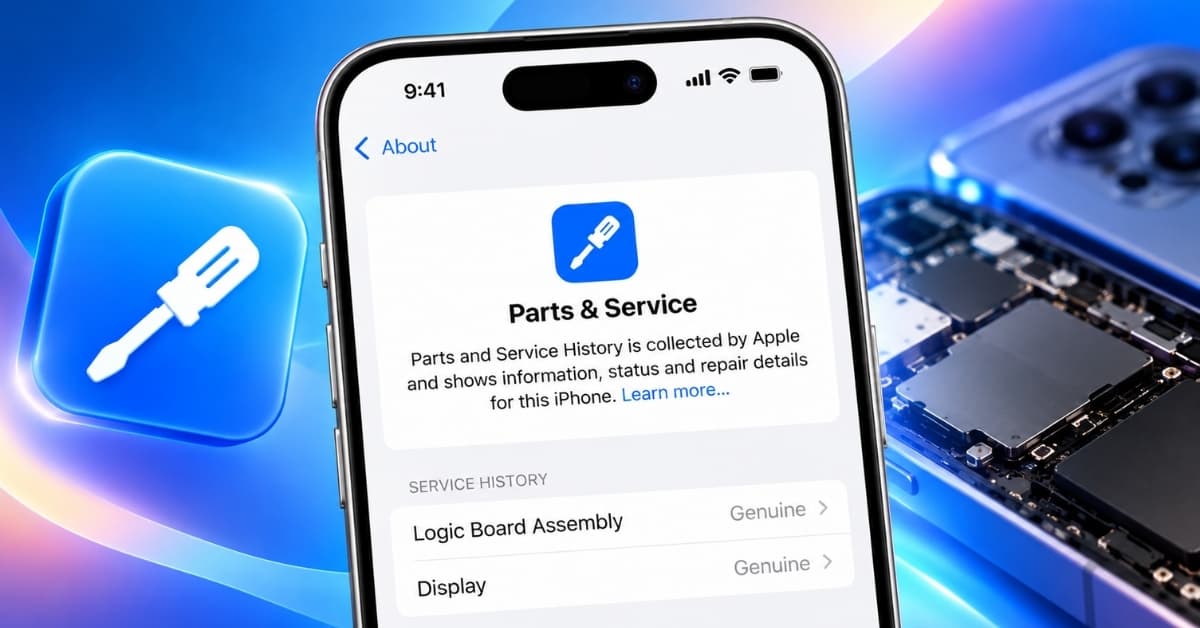
When you send your iPhone for a repair or plan to buy a refurbished one, its service history is more important than most people realise. Apple’s Parts and Service History feature makes it easy to see whether key components like the screen, battery, display, camera, or Logic Board have been replaced.
In this guide, you’ll learn how to check Parts and Service History on your iPhone and understand what each label really means, so you can make smarter decisions with confidence.
What is parts and service history on iPhone?
Parts and Service History is a built-in iOS feature that logs any component that has been replaced or serviced. It indicates whether the part is genuine Apple hardware, an unknown third‑party component, or a used part that was previously installed in another device.
Apple introduced this feature to:
- Improve repair transparency.
- Protect users from poor-quality components.
- Help buyers verify that the repair used genuine Apple parts.
- Check the used or refurbished iPhone is original, avoiding scams.
Having genuine parts is important as they work better and last longer. Also, it helps keep up the resale value of your iPhone.
How Apple’s parts and service history works
Apple uses software and repair-calibration processes to identify and configure replaced components. When a supported repair is completed, Apple’s systems can verify the component and install the calibration data required for it to work correctly.
For supported repairs, Repair Assistant can finish the calibration process after a part is replaced. On supported devices, it can also calibrate a previously used part from another device of the same model.
The best part is:
- You cannot edit or reset this section. If a component has been serviced more than once, only the most recent service appears.
- Apple does not track personal data.
- It is strictly read-only information.
Note:
If your iPhone has never been repaired, the Parts and Service History section will not appear at all.
When you should check parts and service history
You should check this section in several situations:
- Before buying a used or refurbished iPhone: Verify repair claims, confirm genuine parts, and avoid hidden issues.
- After screen, battery, or camera replacement: Ensure the repair was completed correctly.
- When troubleshooting performance issues like battery draining fast, Face ID or camera problems, or display issues.
- Before selling or trading in your iPhone: Buyers may check it for genuine parts, which increases trust and value.
iPhone models that support parts and service history
Apple gradually rolled out this feature across models starting from iOS 15.2 and later:
| Models | Parts |
|---|---|
| iPhone XR, XS, XS Max, SE (2nd and 3rd gen) | Battery |
| iPhone 11 series | Battery and display |
| iPhone 12 series and newer | Battery, display, Logic Board assembly, front camera, and rear camera |
If you have an iPhone 15 or later, you can also see if the replaced Apple hardware was previously used in another iPhone.
How to see parts and service history on iPhone (step by step)
Follow these simple steps:
- Open Settings and go to General.
- Tap About.
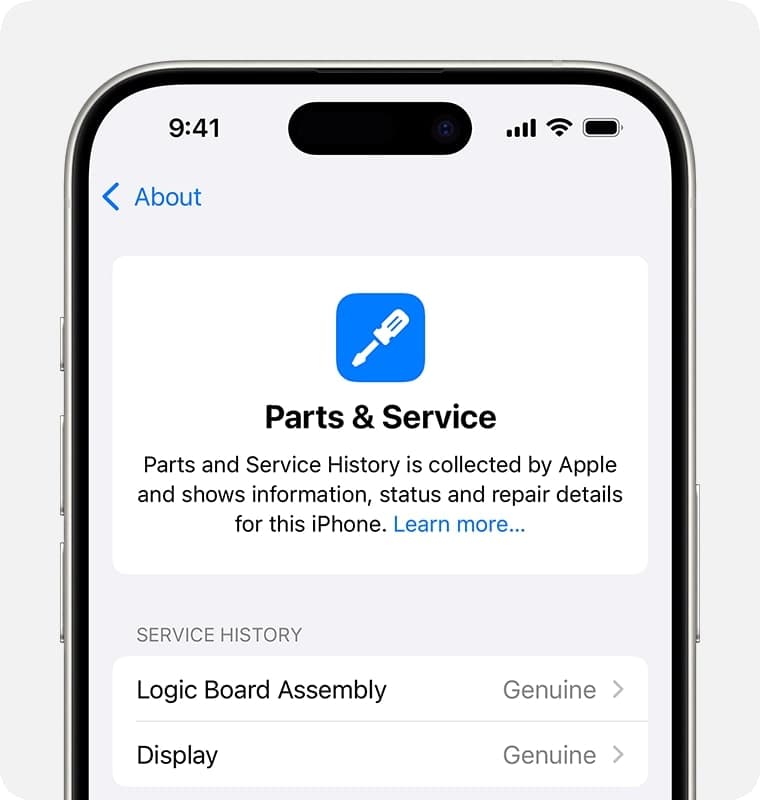
- If your iPhone has been repaired, you will see Parts and Service History.
- Tap it to see the list of replaced components like Display, Battery, Camera, etc.
- Each part shows a status label such as Genuine, Used, Unknown, and Unverified.
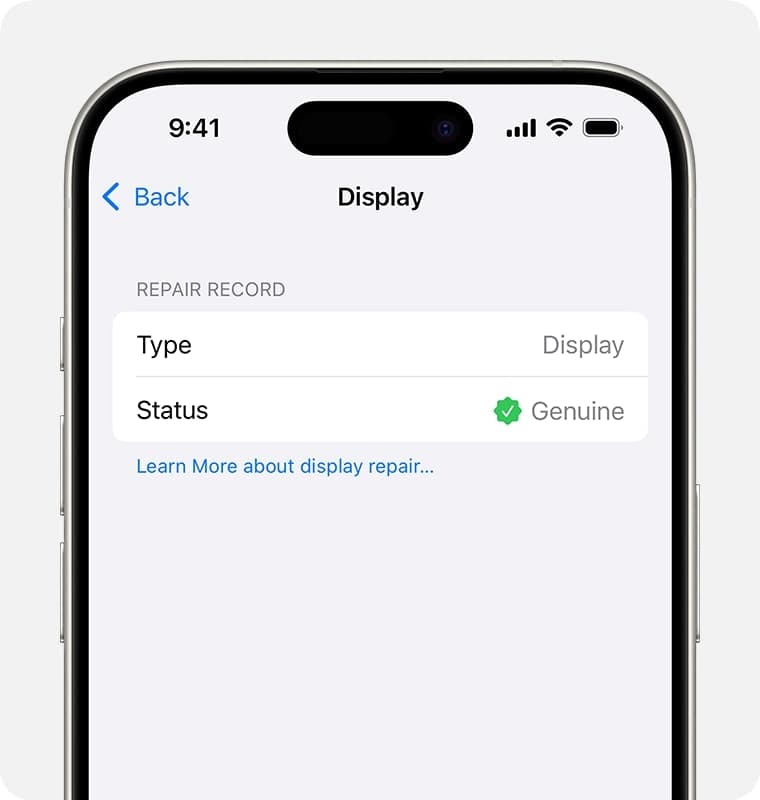
- Tap the component for more information about it, including the date of service. Ensure your iPhone is connected to the internet.
If the repair was not completed, it shows a Finish Repair message. It means the repair has not yet completed the required calibration process.
Understanding parts and service history labels
- Genuine: Official Apple component properly paired and calibrated.
- Used (iPhone 15 and Later): Genuine Apple part previously used in another iPhone. Still verified by Apple.
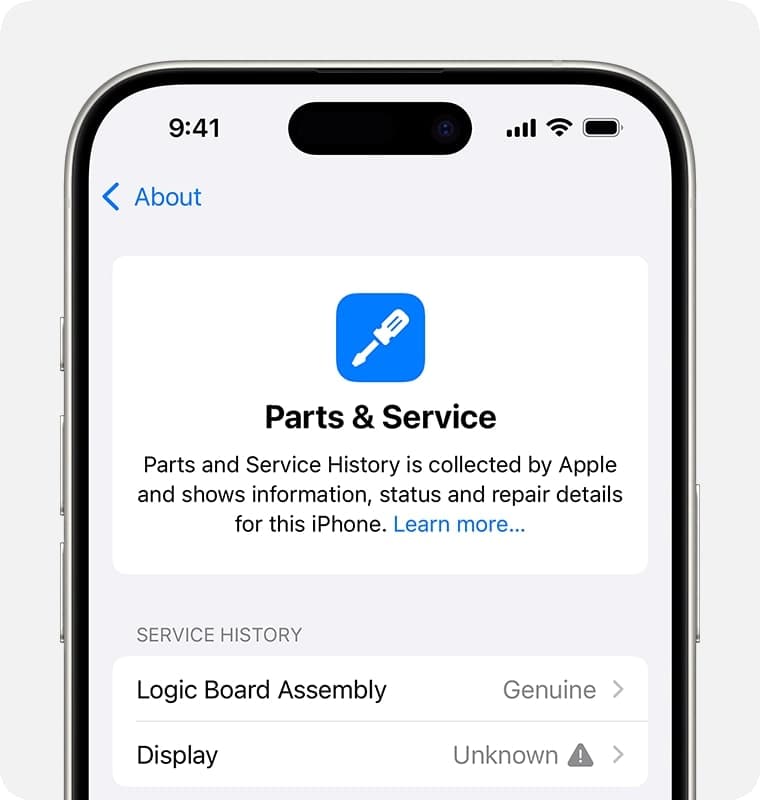
- Unknown: Apple cannot verify the part. May be third-party or improperly installed.
- Unverified: Logic Board was previously replaced as part of a repair. This may affect certain features, such as Apple Pay.
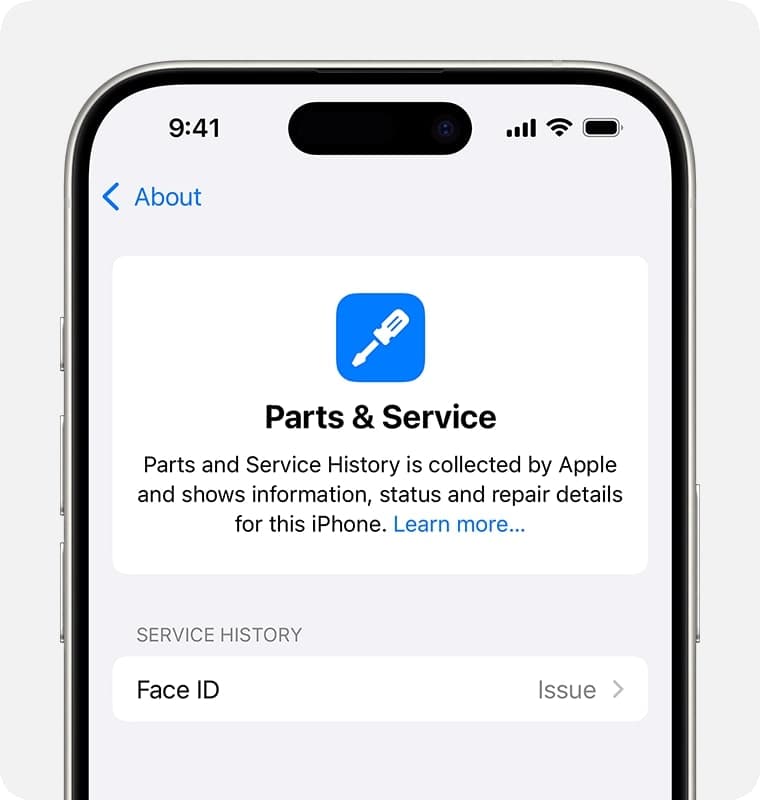
- Finish Repair Message: If the setup or calibration was not done after the replacement, you will see it. You can’t use Face ID or Touch ID to unlock your device or to sign in to apps until it’s done.
To finish the repair, connect the iPhone to Wi-Fi and make sure the battery is above 20 per cent. Then open Settings > General > About > Parts & Service History. Tap Restart & Finish Repair. Finally, follow the on-screen instructions.
What genuine Apple part means
A Genuine Apple Part means the repair was completed using genuine Apple parts and Apple’s repair/calibration processes.
It does not necessarily mean the repair was performed only by Apple or an Apple Authorised Service Provider. Apple also provides genuine parts to Independent Repair Providers and, where supported, through Self Service Repair.
Benefits
- Proper calibration and compatibility with supported iOS features.
- Repairs meet Apple’s performance, security, privacy, and safety expectations.
- A clearer repair record for buyers and trade-in providers.
- Higher resale and trade-in value.
- Safer long-term use.
What used part means
A Used label means the part was already used or installed in another iPhone.
On supported iPhone models, Repair Assistant can calibrate compatible reused parts from another device of the same model. A used part may function differently from a new part because of prior use or modification.
What unknown part or non-genuine part means
This label appears when Apple cannot verify the replacement part or its repair status. It can appear when a part is non-genuine, isn’t functioning as expected, hasn’t been verified and linked after the repair, or has been modified or otherwise cannot be verified.
An Unknown label does not automatically prove that a part is counterfeit or that the iPhone is unsafe. It means Apple could not verify the part or repair status. An Unknown part might affect the trade-in value of the device.
Possible downsides
- Battery health issues.
- Face ID or camera problems.
- Lower resale value.
- The part may not perform as expected.
- Some repaired functions may require further diagnosis or calibration.
- The Unknown label may affect trade-in value.
Messages about replaced parts or multiple repairs
To help you combat poor-quality servicing, your iPhone shows a notification the first time you unlock it after a repair and again in five days if an unknown part is found.
This indicates the replacement part:
- Is non-genuine.
- Isn’t functioning as expected.
- Hasn’t been verified and linked to your iPhone after the repair was done.
- Has been modified or can’t be verified.
You can contact the repair service provider about this.
For display and battery repairs, you may also see the message “Apple has updated the device information for this iPhone.” Apple says this indicates that it has updated device information maintained for safety analysis and to improve future products.
If a component problem significantly affects the device’s functionality and needs attention, your iPhone can show a one-time notification that remains in Parts and Service History until dismissed.
What to do if your iPhone shows unknown or unverified parts
You have a few options:
- Visit Apple, an Apple Authorised Service Provider, or a reputable Independent Repair Provider with access to genuine Apple parts.
- Ask the repair provider to diagnose the part and complete any required calibration.
- Replace the part with a genuine Apple component. If the issue involves a previously used part, check whether it is protected by Activation Lock.
- If buying a used iPhone, ask the seller about the repair and consider the potential effect of an Unknown part on trade-in value.
If buying a used iPhone, you may negotiate the price or consider returning the device to avoid future hassles and security issues.
Note:
that repairs performed by Independent Repair Providers are not covered by Apple’s warranty or AppleCare plans, although the provider may offer its own repair warranty.
Best Practices to Keep Service History Clean
- Choose Apple, an Apple Authorised Service Provider, Apple’s Self Service Repair program, or an Independent Repair Provider with access to genuine Apple parts where supported.
- Complete repairs properly and check everything before accepting the device.
- If Finish Repair appears, complete the repair with Repair Assistant.
- Check Parts & Service History after the repair.
- Keep service receipts and repair documentation.
- Before a trade-in, make sure there are no unfinished repairs and prepare the device using the current iOS 27 Ready for Repair or Trade In workflow when applicable.
Note:
If you have multiple repairs for the same component, your iPhone will show the status of the most recent repair.
Final thoughts
Checking Parts and Service History on iPhone is simple but extremely powerful. It helps buyers avoid scams, owners verify repair quality, and sellers understand what a future buyer or trade-in provider may see.
For iOS 27, the feature is more useful than ever because Apple now distinguishes between Genuine, Used, Unknown, and Unverified parts and provides Repair Assistant for completing calibration on supported repairs.
If you are preparing an iPhone for repair or trade-in, iOS 27 also gives you a new Ready for Repair or Trade-In workflow through Find My, making the preparation process different from older iOS versions.
If you found this guide helpful, save it and share it with anyone buying or selling an iPhone.